Sustainability frameworks operate in a simple hierarchy:
Insights
Key Sustainability Frameworks for Meetings & Events
2026.01.06
- # Insights
- # Event Solution
- # Trade Shows
- # Business Travel
- # North/South Americas
- # Europe
- # Asia
- # Hawaii
- # Korea
- # China
- # Oceania
- # Micronesia
Sustainability has become a core expectation in meetings and events. Yet, many organizers are unsure how different sustainability frameworks work, how they complement one another, and how they apply to events. Understanding these helps teams align event decisions with corporate strategy and regulatory expectations.
Sustainability now shapes how organizations plan and evaluate their meetings and events. However, the sustainability ecosystem can feel confusing because frameworks come from different bodies, serve different purposes and operate across different levels of an organization.
A basic understanding of these frameworks gives event owners and planners a stronger foundation. It clarifies what their organization cares about, what must be reported, and what practical guidance they can use to deliver more responsible events. With this clarity, event teams can confidently support corporate sustainability commitments while improving their own planning processes.
Three Categories of Sustainability Frameworks
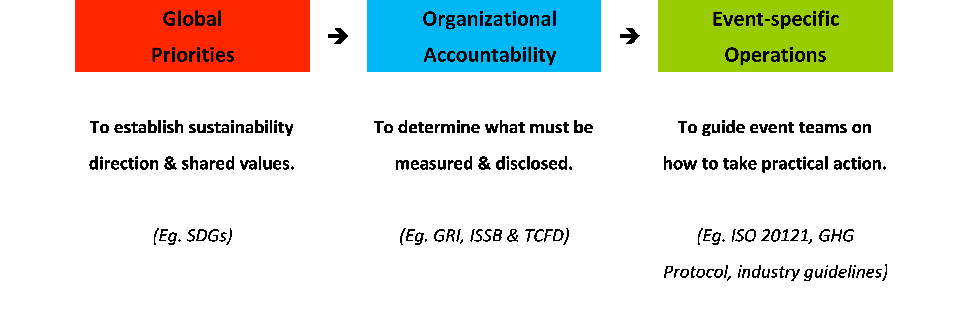
Below we outline the key sustainability frameworks at each level, and what role each plays in supporting more responsible meetings and events.
Big-picture Direction: Global Sustainability Priorities
• United Nations (UN) Sustainable Development Goals (SDGs)
The SDGs provide a universal blueprint for sustainable development across themes such as climate action, responsible consumption, equality and well-being. Organizations frequently use the SDGs as a compass for setting sustainability intentions. They are not event-specific and do not prescribe measurement, but they provide the “why” behind sustainability efforts. For meetings and events, the SDGs help teams:
- identify overarching sustainability priorities,
- communicate intentions consistently, and
- align event planning with corporate direction.
Measurement & Reporting: Structured Organizational Accountability
Reporting frameworks define what sustainability information an organization must measure and disclose. They strongly influence what event teams need to track, making early awareness essential. Understanding these frameworks allows event planners to begin with the end in mind – designing processes to collect the right data from the start.
• Global Reporting Initiative (GRI)
GRI outlines what organizations should report across environmental and social impacts: emissions, waste, resource use, labour practices and supply chains. Event activities often contribute directly to these datasets, including waste diversion, venue energy use and supplier practices.
• International Sustainability Standards Board (ISSB)
ISSB offers globally consistent, investor-focused sustainability reporting standards. Many organizations are shifting toward ISSB compliance for regulatory and market alignment.
• Task Force on Climate-related Financial Disclosures (TCFD)
TCFD helps organizations explain how climate risks may affect their business. It focuses on governance, strategy and risk – not on calculating emissions. For events, this matters because high-impact activities such as travel, logistics and resource use may be considered when organizations assess climate-related risks.
Event-specific Operations: Practical Guidance
Operational frameworks and tools provide the practical “how-to” for implementing sustainable event practices.
• ISO 20121 – Event Sustainability Management System
ISO 20121 is the only global sustainability standard built specifically for the events industry. Organizations may pursue full certification or simply apply the framework for internal improvement. It helps teams:
– plan and deliver sustainable events,
– manage resources more efficiently,
– reduce risks,
– improve accessibility and community outcomes, and
– continually refine performance.
Common complementary tools (NOT frameworks) include:
• Greenhouse Gas Protocol (GHG Protocol)
This global standard categorizes and facilitates calculation of carbon emissions, including event-related Scope 3 category.
– Scope 1: Covers direct emissions from owned / controlled sources.
– Scope 2: Covers emissions from purchased energy.
– Scope 3: Covers all other indirect emissions across the value chain. This is the largest category for most organizations, especially for events. It encompasses attendee travel and accommodation; venue energy use (when not directly billed); catering, materials and production; supplier emissions; and waste generation.
• Destination sustainability indexes such as Global Destination Sustainability Index (GDS-Index)
These indices offer benchmarks that guide event teams in choosing sustainable destinations.
• Industry codes of practice such as International Congress and Convention Association (ICCA), The Global Association of the Exhibition Industry (UFI), and Meeting Professionals International (MPI)
These codes offer operational guidance widely referenced by event professionals.
Bringing the Frameworks Together
These frameworks function at different levels but complement one another. Global principles provide direction, reporting frameworks define what organizations must measure and communicate, and operational tools guide event teams on how to put sustainability into practice. Together, they give organizations both the big-picture rationale and the practical structure needed to plan more responsible meetings and events.
By understanding the different layers and the purpose each serves, event teams can make clearer decisions, align more closely with organizational sustainability goals, and contribute meaningfully to long-term environmental and social impact.
Get a one-glance overview in “Structured Summary of Key Sustainability Frameworks for Meetings & Events”.