For corporate meetings and events (M&E) teams and procurement professionals, the following process connects the initial brief to a practical shortlist. Use it for an event in one market or, where multiple markets are in scope, adapt the response fields to the locations that need distinct answers. The aim is to compare proposed delivery, not simply the presentation of a proposal.
Insights
How to Create an Event Management RFP for Global Events
2026.11.06
- # Insights
- # Event Solution

Comparing event management proposals becomes difficult when vendors describe different services, assign responsibilities differently, or leave important costs unexplained. Before comparing prices or creative ideas, give each bidder a common brief and ask for evidence relevant to the work you need.
What Is an Event Management RFP?
An event management request for proposal (RFP) is a buyer-issued document asking prospective providers to explain how they would deliver a defined event. It sets out the requirements and invites proposals covering scope, responsibilities, timing, commercial assumptions, and relevant experience.
A full-service event management RFP concerns the overall work assigned to an event management company. A venue-only or audiovisual request concerns a narrower service. A destination management company may also receive a separate brief for local services. Choose the request that reflects the work you are actually commissioning; do not assume one supplier category covers every task.
This guide focuses on preparing the buyer's RFP and assessing replies, rather than finding tender opportunities or writing a supplier's bid.
Step 1: Define the Event Scope Before Requesting Proposals
Clarify the Event Goals, Format, and Locations
State what the event should achieve, its format, expected dates, and location or locations. Explain the participant context and any requirements already established by your organization. State which details are confirmed and which remain open for vendor proposals.
For example, a confirmed location and an open choice of venue call for a different response from a request to recommend the event location itself. Label those choices clearly instead of leaving bidders to infer them.
Name the buyer's decision-making contact and explain which decisions need further approval. Include regional or local stakeholders only where they have a defined role in the requested scope. An event in one market need not be described as an international operation.
Set the Scope, Budget Assumptions, and Response Rules
Separate the work you are requesting from tasks your team or another supplier will handle. Identify dependencies, such as an already-appointed venue or a production supplier whose work must be coordinated.
Provide a budget range where appropriate, or explain the assumptions vendors should use when preparing prices. State which options should be priced separately. When a requirement is unresolved, ask bidders to disclose their assumptions rather than silently choosing different starting points.
Where registration, event technology, or reporting is in scope, describe the information and outputs you need, plus any known systems or suppliers the appointed vendor would need to coordinate with.
Set a proposal deadline, response format, and process for clarification questions. Explain the broad evaluation criteria before proposals arrive. Where a clarification changes the brief, provide the same substantive update to all bidders.
Step 2: Ask Each Vendor for Comparable Delivery Evidence
Identify Delivery Owners and Direct vs. Partner Responsibilities
Ask each bidder to identify who would manage the proposed work and which services its own team or partners would deliver. The response should describe the delivery team, not only the people presenting the proposal.
For locations where it is relevant, request an accountable contact and an explanation of how decisions and problems would be escalated. Where headquarters, regional teams, or local teams have defined roles, ask how those responsibilities connect. For a simpler event, keep the reporting arrangement proportionate to the scope.
A statement of geographic presence is not, by itself, an explanation of how a particular service would be delivered. Ask for experience or supporting information that relates to the location and work being proposed. Where a partner would perform a task, clarify who would coordinate it and remain accountable to you.
A vendor's previous project should illustrate relevant work, not simply display a recognizable client name. Ask which elements of that experience relate to this proposal.
Example: A Vendor Response and Evidence Table
Give every bidder the same core response fields. Where several markets are in scope, add market-specific response fields where requirements, delivery arrangements, or supporting evidence need separate answers.
Illustrative buyer-created response checklist.
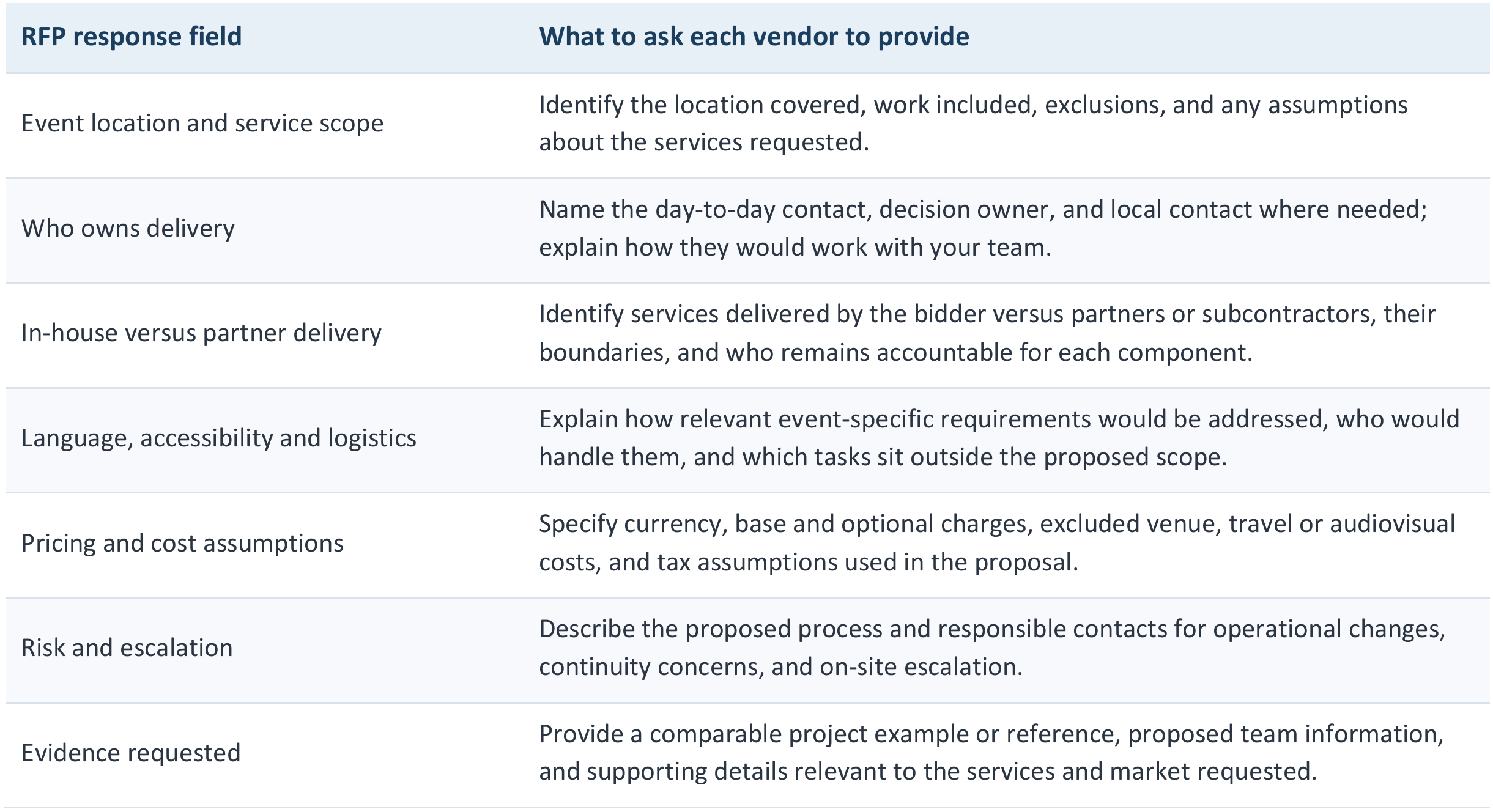
Allow bidders to mark a field not applicable and explain unavailable information. Keep those explanations alongside their answers, and assess whether the evidence supplied actually addresses the requirement.
Step 3: Evaluate Proposals Against Clear Criteria
Check Scope, Cost Assumptions, and Supporting Proof
Compare equivalent work before comparing quoted totals. Check whether each price covers the requested services, whether optional charges are separate, and which assumptions remain unresolved. A lower total for a narrower scope is not a like-for-like comparison.
Read supporting examples against the specific requirement they are meant to address. A reference may demonstrate experience in a relevant market without covering every service in your brief. Record the connection between the evidence and the proposed work, as well as gaps requiring clarification. Keep a persuasive description separate from the supporting proof.
Use an Evidence-Based Scoring Approach You Can Adapt
Choose evaluation criteria that reflect your event priorities, then apply them consistently to each proposal. Relevant dimensions might include scope fit, delivery ownership, experience, commercial clarity, and the proposed approach to operational changes. Agree their meaning within the buying team so reviewers assess the same requirement, even when their responsibilities differ.
As an illustrative, buyer-defined starting point, classify each response as documented, needs clarification, or not demonstrated. Documented means the supplied material addresses the criterion; needs clarification identifies an incomplete or ambiguous answer; not demonstrated means the requested evidence has not been provided. These labels describe the submission, not a definitive judgment of the vendor's ability.
For an event RFP scoring matrix, you can add buyer-selected ratings or weights where useful. Record the reason and evidence behind each assessment. Adjust importance to your event rather than treating a published example's percentages as a universal rule. Keep the same assessment basis across bidders.
Step 4: Shortlist Vendors and Resolve Open Questions
Use the assessments to identify vendors whose proposals warrant further discussion. For each shortlisted bidder, prepare specific follow-up questions tied to gaps in its response rather than asking for another general presentation.
Invite the proposed delivery team to explain unresolved responsibilities, assumptions, or supporting examples. A clarification should address the original requirement or make clear where the proposed approach differs. Where answers change the scope or price, request an updated proposal so your comparison reflects the current offer.
Record why each vendor remains under consideration and what remains unresolved. Keep unanswered questions visible rather than burying them in an overall score. Use this record to decide which candidates warrant further commercial discussion; treat contract negotiation as a separate step in your process.
Frequently Asked Questions About Event Management RFPs
Can One RFP Cover Events in More Than One Market?
Yes. Where several markets are in scope, you can use a common core brief with separate market-specific response fields where needed. Make clear which requirements apply everywhere and which differ by location. Ask vendors to identify the markets their proposals cover, rather than assuming a response to the overall brief covers every location.
What If a Bidder Cannot Provide the Requested Evidence?
Record what is missing and ask whether clarification or a relevant alternative would address the requirement. Do not treat unavailable evidence as either proof of capability or proof of inadequacy. Consider what the alternative demonstrates and what it leaves unanswered, rather than marking it equivalent without review. Assess the explanation consistently with other bids, while keeping any remaining uncertainty visible in the selection decision.
Can I Use an Event RFP Template Without Adapting It?
Treat a template as a starting point, not a finished brief. Adapt its questions to your event scope, delivery responsibilities, evidence needs, and pricing assumptions.
Next Steps: Discuss Your Event Requirements
Before approaching a potential event partner, bring together your event scope, relevant locations, and the questions your RFP needs to resolve. Distinguish decisions already made from areas where you would like a proposal or further discussion.
For additional context, explore JTB's Event Solution and Global Network pages. Use your brief to discuss the particular services, responsibilities, and local requirements involved in your event and identify the points that still need a response.