1. Clarify Your Goals
Are you aiming to build relationships, share knowledge widely, or maximize visibility?
2. Define Your Audience
Consider audience location—local, regional, or global.
Time zones, travel restrictions, and budget constraints will influence feasibility.
3. Set Budget and Resources
Factor in both direct costs (venues, platforms, technology) and indirect costs (travel time, staff capacity, sustainability impact).
4. Consider Engagement Depth
Decide whether deep engagement and trust-building or broad digital reach is your top priority.
5. Measure Against Past Data
Use SMM insights from previous events to benchmark cost, participation, and engagement metrics.
Insights
Event Format Selection Guide: Choosing Between In-Person, Virtual, and Hybrid Events
2025.10.06
- # Insights
- # Event Solution
- # Business Travel
- # Group Travel
- # North/South Americas
- # Europe
- # Asia
- # Hawaii
- # Korea
- # China
- # Oceania
- # Micronesia
Choosing the right event format is no longer about following trends—it’s about aligning your event strategy with business objectives, budget, and audience needs.
This Event Format Selection Guide provides a clear comparison of in-person, virtual, and hybrid events, helping planners evaluate what works best.
Through Strategic Meetings Management (SMM), you can apply consistent standards and data-driven insights across all formats to achieve measurable business outcomes.
Key Considerations at a Glance
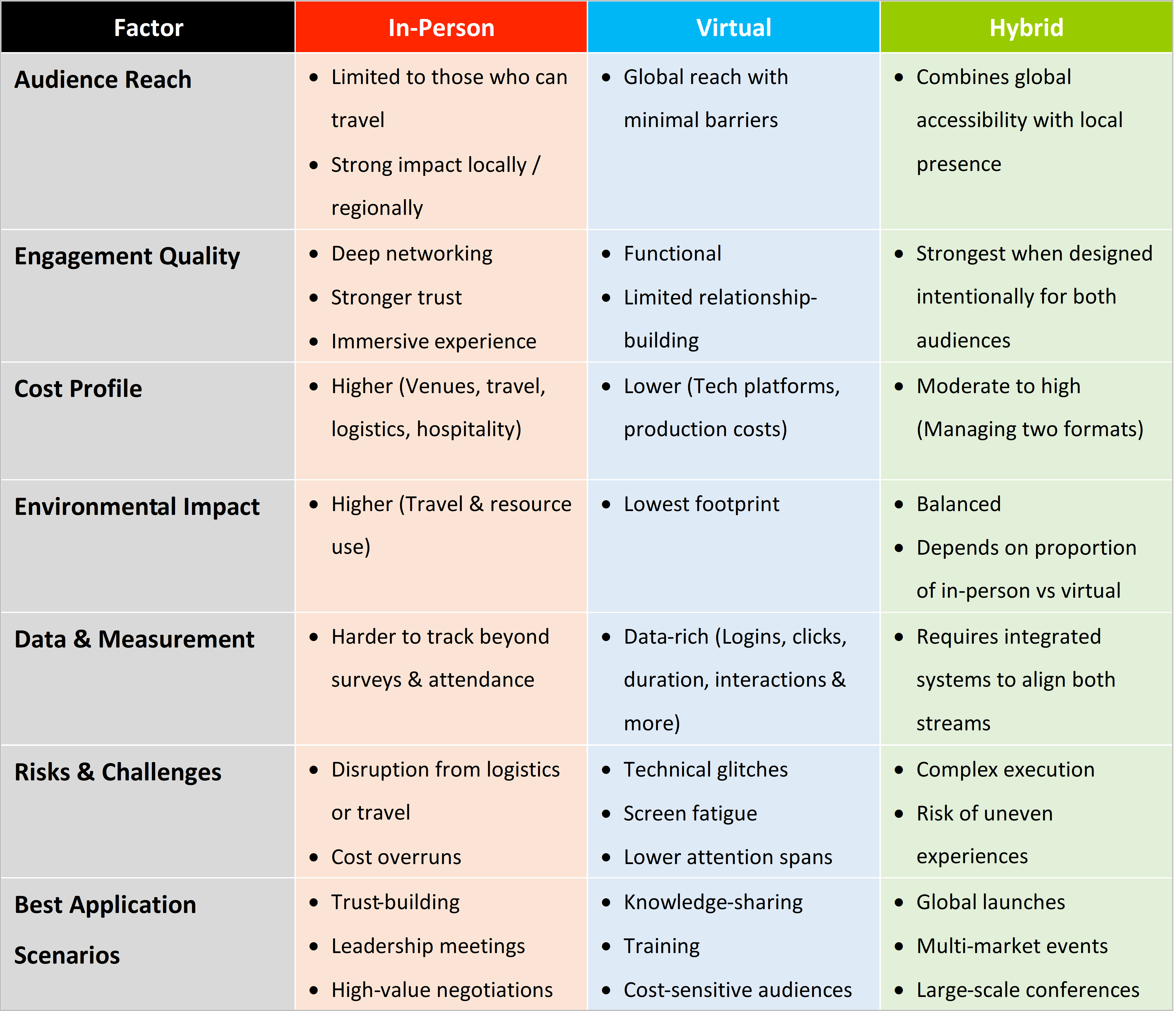
How to Use This Guide
Why SMM Matters in Format Selection
Strategic Meetings Management (SMM) ensures that whichever event format you choose, outcomes are planned, measured, and comparable.
By applying consistent SMM metrics across in-person, virtual, and hybrid events, organizations can evaluate cost per participant, engagement levels, and return on investment (ROI).
This transforms format decisions from speculative to evidence-based, creating transparency and accountability in event strategy.
This guide is not a one-size-fits-all prescription but a decision-making framework.
Every event is unique. By integrating SMM principles, organizations can choose formats that deliver measurable impact, maximize engagement, and adapt flexibly to evolving business needs.
For deeper insights, explore our related article:
“From In-Person to Hybrid: Maximising Impact Across Event Formats with SMM”.
Insights
Learn More