Bleisure travel – where a business trip is extended for personal time – is becoming increasingly common. Employees may arrive a day early, stay over a weekend, or briefly extend a trip after meetings conclude. Many organizations are open to these requests.
Without clear guidelines, however, what appears to be a simple flexibility for employees can quickly become a governance, cost and risk management issue. Organizations that define boundaries early can support employee flexibility while maintaining appropriate oversight.
Insights
Bleisure Travel: Managing the Work-Leisure Boundary in Corporate Travel
2026.04.22
- # Insights
- # Group Travel
- # Event Solution
- # Business Travel
- # North/South Americas
- # Europe
- # Asia
- # Hawaii
- # Korea
- # China
- # Oceania
- # Micronesia
When business travel extends into personal time, organizations must balance employee flexibility with governance, risk management, and internal fairness. A clear bleisure framework helps companies define responsibility, maintain traveler visibility and manage costs consistently.
Establishing Clear Policy Boundaries
A workable bleisure policy rests on three foundations: clear cost rules, defined insurance coverage, and a straightforward approval process.
The cost principle is simple. The organization pays what it would have spent for the business trip alone, while the employee covers any additional costs associated with personal travel. Accommodation, meals and incidental expenses during personal days are generally not reimbursable. Finance Teams should also be aware that covering leisure expenses can create taxable benefit implications, particularly when family members are involved.
Corporate travel insurance normally applies only to the approved business portion of the trip. Personal extensions, accompanying travelers, and higher-risk leisure activities are often excluded, so employees should arrange their own coverage when necessary.
Approval processes do not need to be complex. A brief request to the line manager, copied to the Travel Team, is usually sufficient – provided the arrangement is formally recorded.
Managing Duty of Care During Extended Travel
Most corporate travel policies are designed around the approved business itinerary. When personal days are added, the boundaries of an employer’s duty of care become less clear.
An employer’s responsibility may not extend fully into the personal portion of the trip, but it rarely disappears entirely.
For this reason, employees extending travel should update their itinerary in the company travel system and confirm they have reviewed the destination’s risk profile. For higher-risk destinations, a brief check-in with the Travel Team before the personal portion begins can be prudent. Organizations should also communicate clearly that support during personal travel may be more limited than during the business itinerary.
Assigning Ownership Across the Organization
Bleisure travel touches several internal functions, including HR, Travel, Finance, Legal and Security. Without clear ownership, responsibility can become fragmented.
Many organizations designate either HR or the Travel Team as the policy owner while drawing on other functions for specific areas such as insurance, tax and risk management. A clearly identified contact point for employees also helps reduce confusion when requests arise.
In practical terms, organizations benefit from three simple tools: a bleisure addendum within the travel policy, a short employee guide explaining responsibilities, and a basic approval workflow. Companies using managed travel programs should also ensure their Travel Management Company (TMC) understands how to manage fare differences, split itineraries and reporting requirements.
Addressing Equity & Perception Risks
Beyond operational policy issues, organizations should also consider how bleisure travel is perceived internally.
In many companies, only certain roles travel regularly. Functions such as Finance, Accounting, IT or Compliance may rarely have business travel opportunities. When bleisure becomes highly visible, employees in non-travel roles may perceive it as an uneven privilege rather than a logistical extension of work travel.
Clear communication helps manage this perception. Bleisure should be framed as a practical accommodation attached to necessary business travel rather than an additional employee benefit.
Leadership behavior also plays an important role in shaping perceptions. Senior executives often travel more frequently and may have greater discretion over their schedules. If trips appear structured primarily around personal convenience or leisure opportunities, it can undermine policy credibility.
For this reason, many organizations apply the same documentation and approval expectations across all levels of seniority. Business purpose should be clear, and any personal extensions should follow the same cost and disclosure rules applied to other employees.
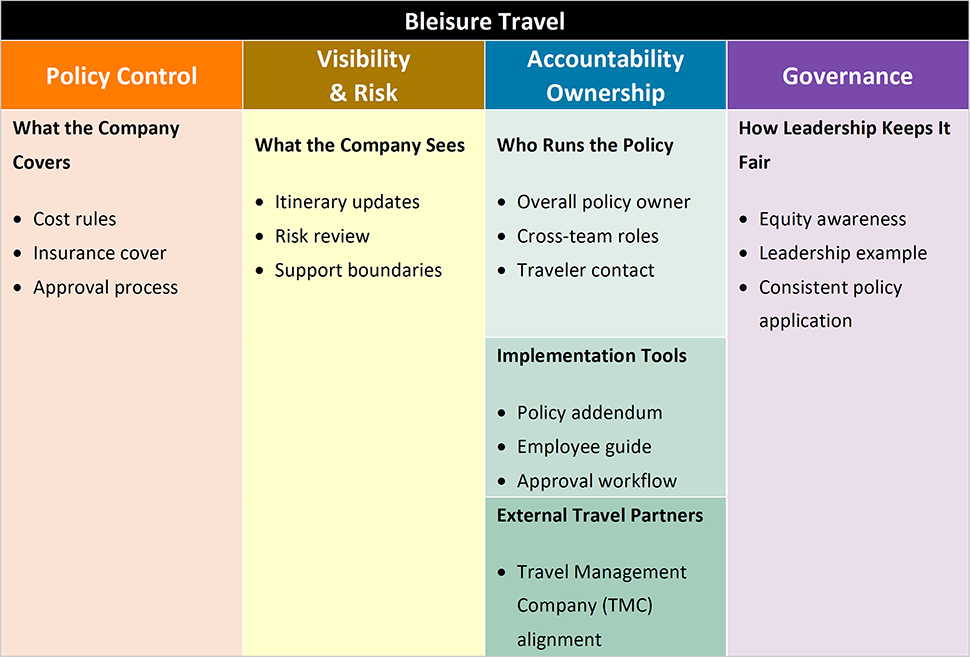
Overview of Managing Work-Leisure Boundary
Key factors organizations must manage to make bleisure travel
both safe and equitable, support flexibility while maintaining control.
Supporting Flexibility While Maintaining Control
Managing bleisure effectively ultimately comes down to clarity and consistency. When employees understand what the organization will cover and what they must arrange independently, these requests are usually straightforward to manage.
As travel volumes recover and hybrid working broadens where employees operate from, bleisure requests are likely to increase. Organizations that establish clear policies now will find it easier to support flexibility while maintaining appropriate oversight.